
Welcome.
At the end of a winding road lies a beach. On the beach is a rock, perfect for sitting and reflecting whilst gazing out over the Sea of Åland. This is where designer Minna Rundberg finds her inspiration.
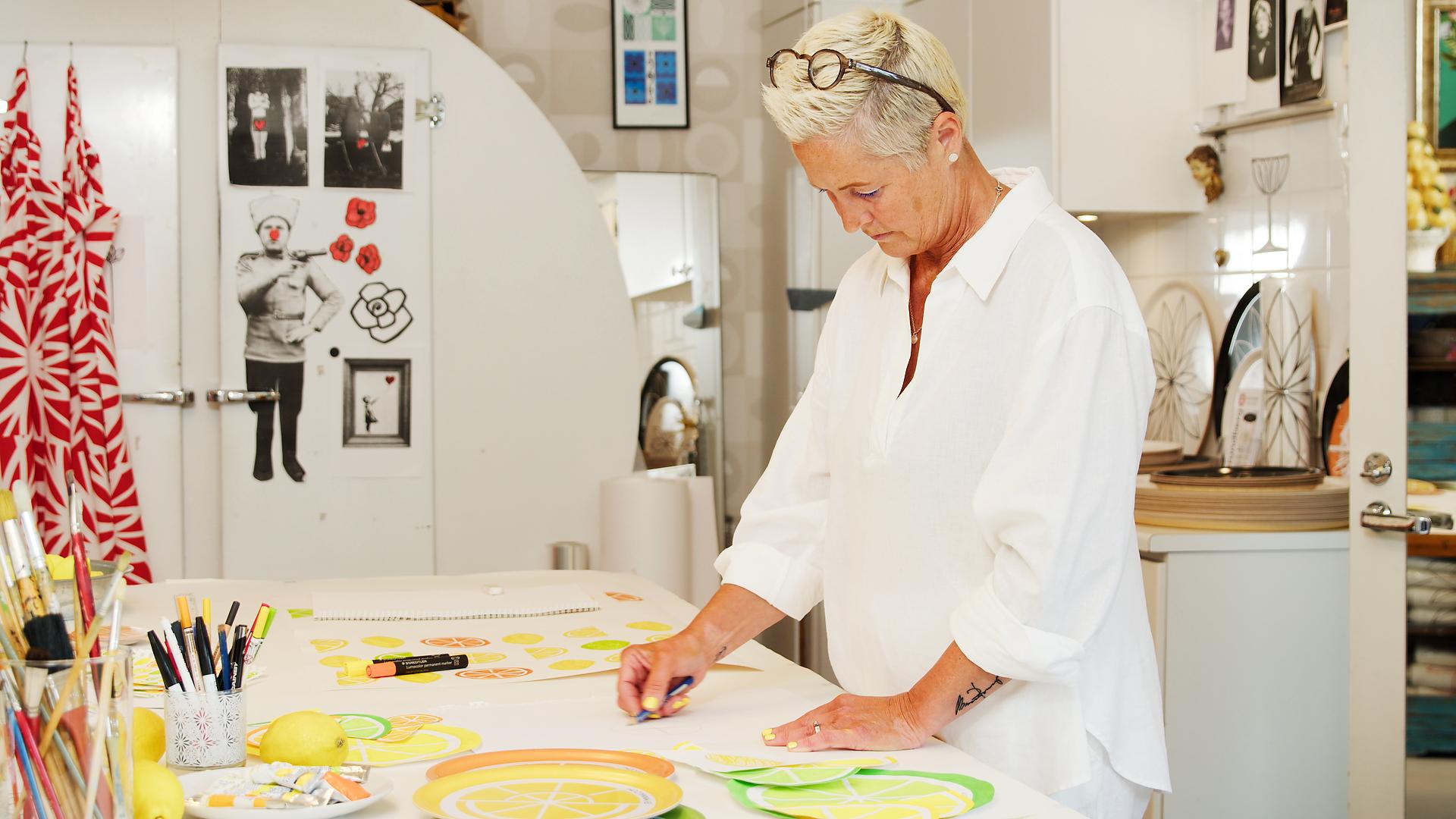
Past a row of cherry trees lies her studio, where yellow, orange and red tables and chairs brighten up a beautifully designed stone terrace. As soon as you step inside, you are greeted by the sound of a bell above the door. The studio consists of two spaces: a showroom where Minna’s products are on display, and a room where she sketches and works.
Beautiful things are everywhere. A cuckoo clock hangs on the wall, a bowl of fragrant lemon soaps catches the eye, a peacock peeks out. And everywhere you look, there is Minna’s design language and colourful products. It really feels as though you are stepping into Minna’s world.
Minna enjoys Konstrundan because it gives her the chance to welcome people into her space. She has been taking part since 2019. But in 2024, Minna was diagnosed with lymphoma, and this year is the first time since being declared cancer-free that she is taking part in Konstrundan again. The illness has made Minna realise what is important, she says. Art is important.
It all began with blacksmithing.
Minna is a trained blacksmith and worked as a craftswoman during the 1990s.
“When you start forging, the iron has a mind of its own; it often bends the way it wants to,” she explains.
As she developed as a blacksmith, Minna wanted to strip things back and make the design more refined.
- Design is very much about problem-solving. Forging a twelve-armed chandelier didn’t work. But forging twelve single-armed chandeliers did.
The result was given the title Big Bang.
The single-armed chandelier looks simple, but there is a lot of work behind it.
The law of gravity dictates that when an arm with a candle protrudes from a hanging point, it ends up at an angle. Minna realised she needed a weight at the bottom to balance the chandelier, but what could she use? One day, whilst out walking with the pram, she found a piece of blasted Åland granite. That’s when the solution came to her.
Bing Bang proved popular and received many orders. Minna spent all her time crafting chandeliers. This sparked her interest in new materials. Since the 2000s, Minna has worked as a designer.
- I am a designer who always takes myself as my starting point.
Minna is known for her bright, cheerful colours and her design language, in which lines and ellipses recur. It was from her ‘thinking stone’, whilst gazing at the sea and the waves, that the inspiration for her design language came.
She designs trays, glassware, fabrics and rugs, which she sells herself.
She is currently working on the Amfora project.The amphora is a historical form, to which people have different relationships. It can be a bottle or an urn. Minna’s amphoras are long, short, thick and narrow. They have different personalities, and when they stand in a row next to one another on a paper, they feel like living characters with something going on.
At the moment, she doesn’t know exactly where the amphora forms will take her. It will be exciting to see for those visiting Minna during Konstrundan in September.
Minna has long worked in a very austere and graphic style, but now she feels she has returned to her earlier creative approach. She allows her forms to remain hand-sketched and freer. She wants to return to art and hand-painted work.
- I play and see where it takes me.
At the moment she finds peace in working with unique pieces.
Sketching is an important part of the process.
Minna always works with sketches. She rolls out large sheets of paper on the floor and draws and paints by hand. She can then alter the size and shapes, and reposition the sketches. She experiments with scale and colour. She lets herself be guided by the process, curious to see what might emerge. During the sketching phase, she works with an open-ended form. She often works on a large scale, making things difficult for herself, as there are limitations on, for example, how large a pattern can be when printed on fabric.
-It’s important that you’re happy with what you’re selling.
Once the right form has been found, it is digitised. It may be tidied up, but at the moment Minna wants the lines to feel hand-painted. Then the design is finished and is not altered any further. The digital files are ready to be printed on all of Minna’s products.
Minna’s background as a craftsperson means she understands the process of how her products are created. Good raw materials and good craftsmanship result in a good end product. She is proud to say that her products are as locally produced as possible. The fabrics, trays and rugs are produced in Sweden and Finland. The glasses are hand-blown in France and glazed in Estonia. The fact that the glasses are hand-blown gives each one a unique sense of high quality, which is important to her.
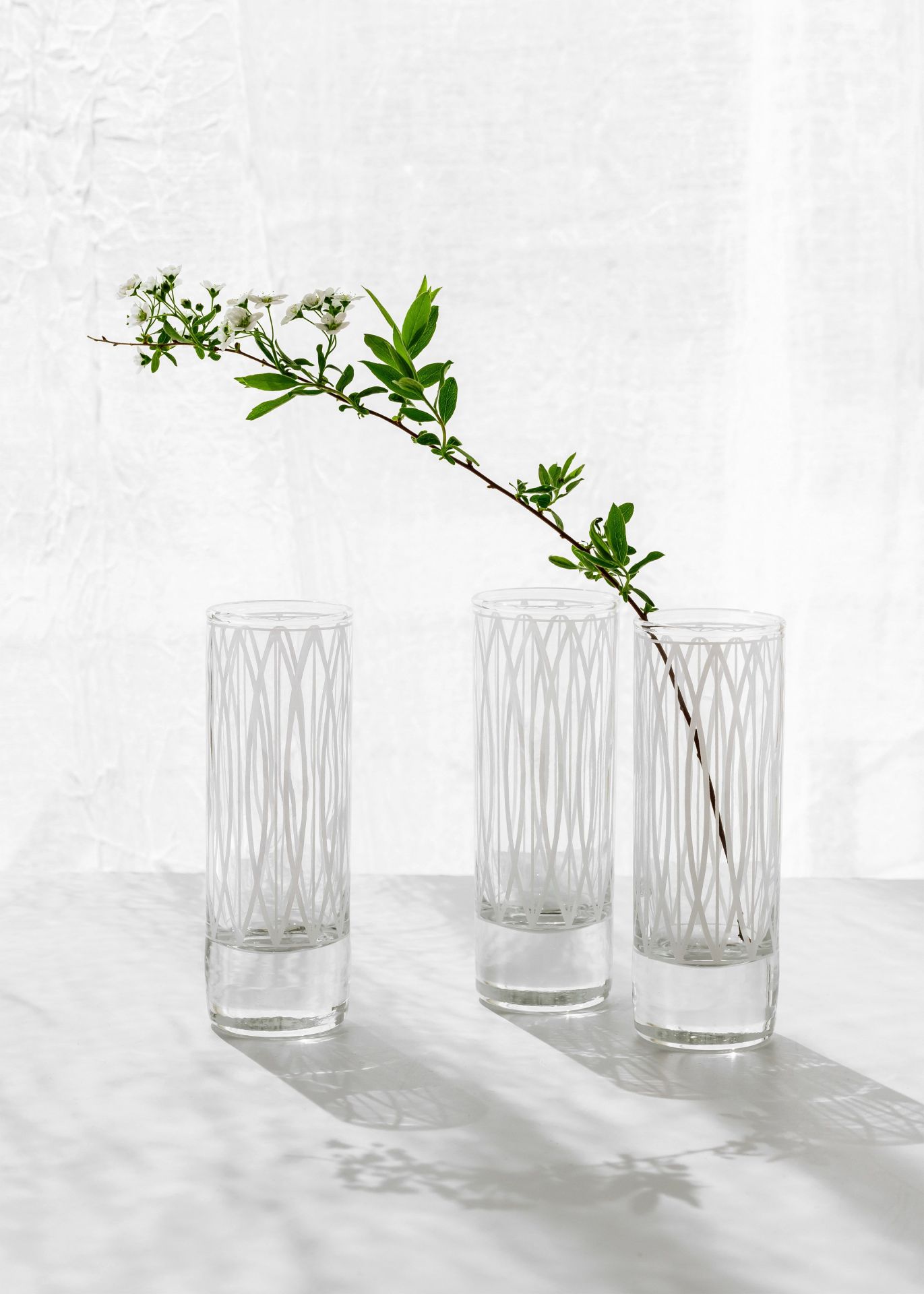
In the summer of 2026, Minna will launch an online shop targeting Finland. The tax border around Åland means that it is not entirely easy for small-scale entrepreneurs to export goods from Åland, but the final details will soon be finalised, and she is ready with a well-stocked warehouse full of beautiful products.
Welcome to the ByMinna online shop and welcome to Minna Rundberg at Konstrundan.